
Sun's Swirling Vortices Captured in Unprecedented Detail by Hawaii Telescope
The Inouye Solar Telescope in Hawaii has captured the most detailed images of the Sun's surface ever recorded, revealing swirling vortices driven by magnetic fields and hot gas motion. These phenomena are crucial for understanding space weather.

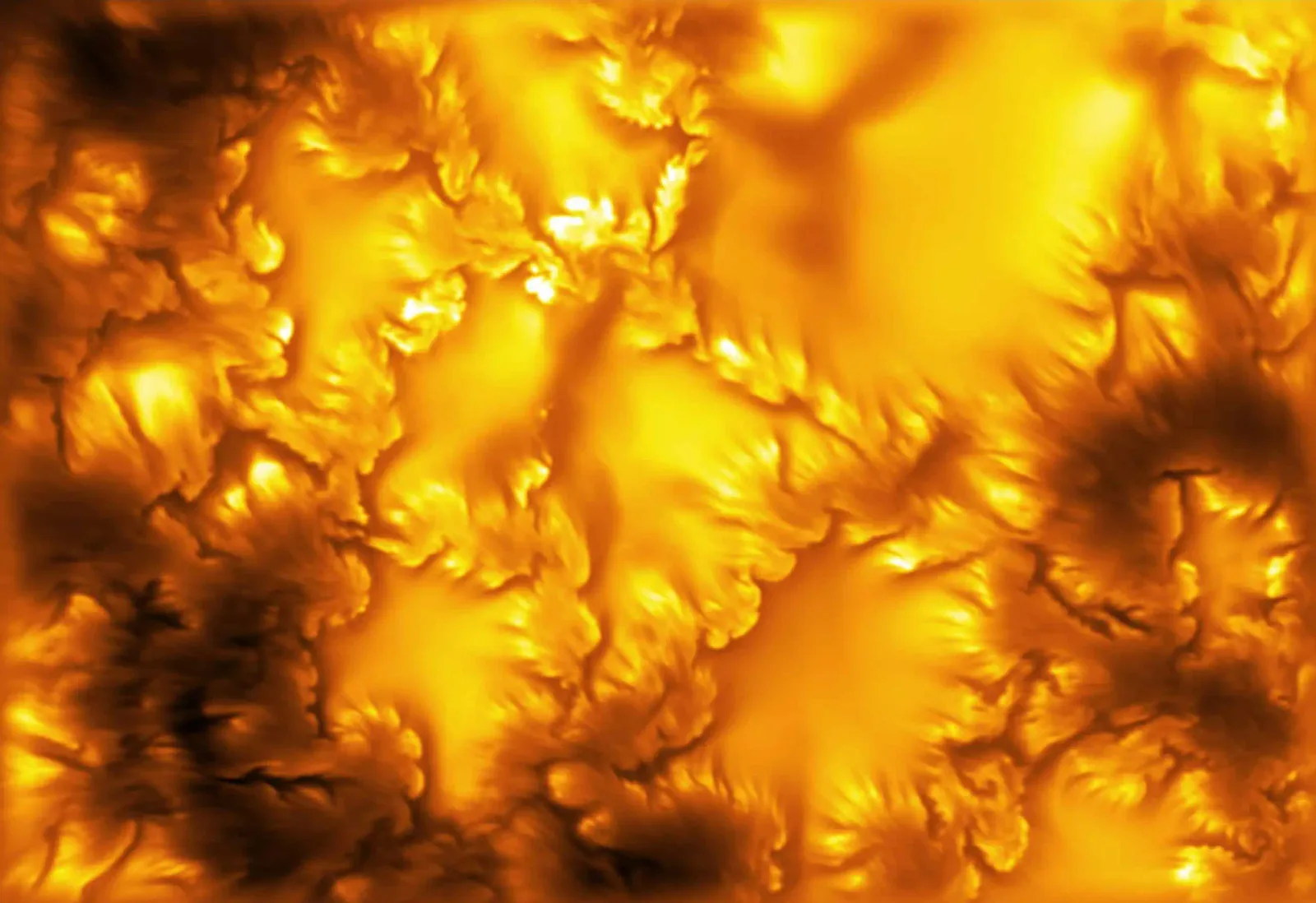
The surface of the Sun has been photographed in unprecedented detail, revealing a dynamic landscape dominated by swirling vortices. These remarkable images, captured by the Daniel K. Inouye Solar Telescope located atop a high peak in Hawaii, offer new insights into the complex processes occurring on our star. The findings were recently published in the journal Nature.
The mesmerizing swirls are a direct manifestation of the Sun's magnetic field being twisted and propelled by the turbulent motion of superheated plasma. Physicists identify this phenomenon as Kelvin-Helmholtz instability, a process observed when two fluids slide past each other, causing minor disturbances to escalate into spiraling vortices. This same instability is responsible for the formation of large waves in Earth's oceans.
According to the National Solar Observatory (NSO), these solar vortices span approximately 50 to 65 kilometers (30 to 40 miles) in diameter. This intense churning activity is the source of some of the Sun's most powerful outbursts. "These twisting motions are creating magnetic energy, which can build up to produce those large-scale explosions," explained Dr. David Kuridze, an astronomer at the NSO, to BBC News. His colleague, Dr. Friedrich Woeger, added that this stored energy is subsequently released in the form of solar flares or coronal mass ejections.
Understanding Solar Outbursts and Space Weather
These energetic releases constitute what is known as space weather, a phenomenon with significant implications for Earth and its inhabitants. Severe space weather events can disrupt power grids, disable satellites essential for communication and navigation, and pose considerable risks to astronauts in orbit. Understanding the intricate physics governing the Sun is therefore paramount for predicting and mitigating the impacts of these solar events.
Dr. David Boboltz of the NSO emphasized the Sun's role as a "unique laboratory" for scientific inquiry. "To figure out and eventually predict space weather, we want to understand the physics of the Sun, all the way down to the smallest scales," he stated. He also highlighted the historical significance of solar observations, noting that "the first experimental proof of Einstein's general relativity came from solar eclipse observations. So simply for human knowledge, we need to have experiments like this." The advanced capabilities of the Inouye Solar Telescope are instrumental in achieving these scientific goals, pushing the boundaries of our understanding of solar dynamics and its far-reaching consequences.