
Total Solar Eclipse 2026: Europe Prepares for Rare Celestial Event
Europe is just one week away from its first total solar eclipse since 1999. The rare celestial phenomenon will be visible across Greenland, Iceland, and northern Spain on August 12, 2026.

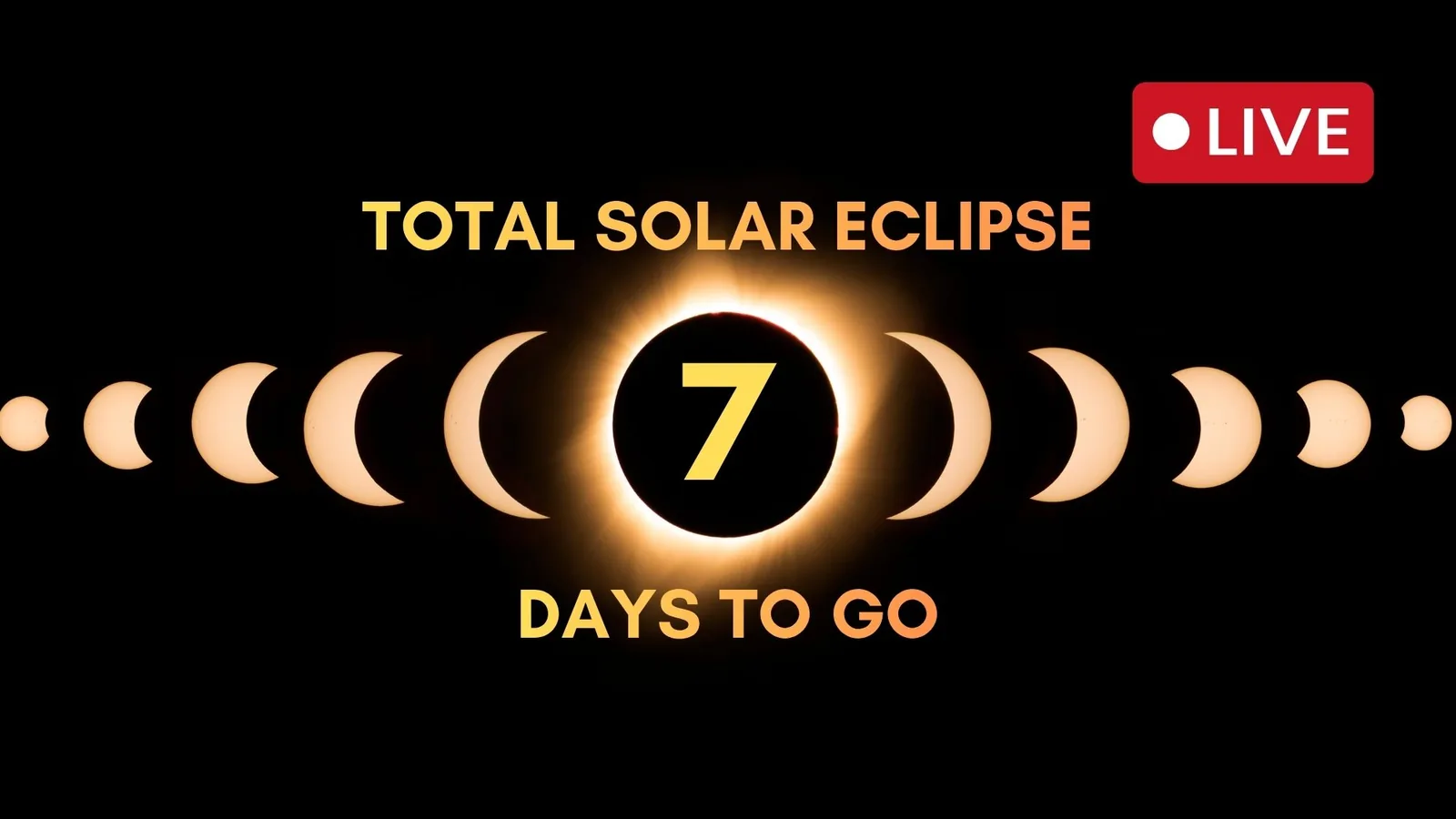
Europe is on the cusp of witnessing a rare and spectacular celestial event: a total solar eclipse set to occur on August 12, 2026. This marks the continent's first total solar eclipse since 1999, promising to darken skies across Greenland, Iceland, and northern Spain. During the brief period of totality, the moon will completely obscure the sun, revealing its ethereal outer atmosphere, known as the corona, and transforming daylight into twilight along the precise path of the eclipse.
Millions more across wider regions of Europe, including parts of the northeastern United States and eastern Canada, will experience a partial eclipse, observing the moon appear to take a significant bite out of the sun. Observers are urged to use certified solar viewing equipment to safely witness the event.
Skywatching journalists Daisy Dobrijevic and Anthony Wood are positioned to provide live coverage. Dobrijevic is currently aboard the HX Expeditions' MS Spitsbergen, navigating Greenland's Scoresby Sund, the world's largest fjord system, in hopes of a clear view. This expedition aims to capture the totality from the Arctic region, a location offering dramatic coastal vistas.
Meanwhile, Wood is stationed in Valoria la Buena, Spain, participating in the Distributed Eclipse Broadcast (DEB) initiative. His vantage point offers a view of the eclipsed sun hanging low above the western horizon as sunset approaches, marking his first experience with a total solar eclipse. The DEB initiative is a citizen science project designed to capture detailed data during the eclipse.
Countdown to Totality: A Week of Anticipation
With just one week remaining until the total solar eclipse, anticipation is mounting. This natural spectacle offers a unique opportunity for scientific observation and public engagement. The path of totality, a narrow corridor across the Earth's surface, is where the most dramatic views will unfold. For those outside this path, a partial eclipse offers a chance to witness a less intense, but still captivating, solar phenomenon.
The upcoming eclipse serves as a reminder of the dynamic celestial mechanics governing our solar system. Eclipses occur when the Sun, Moon, and Earth align perfectly. A total solar eclipse happens when the Moon's apparent size in the sky is large enough to block the Sun entirely, an alignment that occurs approximately once every 18 months somewhere on Earth, though totality is far rarer for any given location.
This event is particularly significant for Spain, which has become a prime location for recent and upcoming eclipses. Following the August 2026 event, Spain is also in the path of another total solar eclipse in 2027, highlighting the country's unique position for astronomical observation. Public engagement programs and scientific research are being coordinated across the affected regions to maximize the scientific and educational impact of the event.