
Venus and Crescent Moon Dazzle After Sunset Tonight
Stargazers can witness a celestial pairing tonight, May 18, 2026, as the bright planet Venus and a razor-thin crescent moon align in the western sky after sunset. The moon, just 2.1 days past new, will appear near Venus.

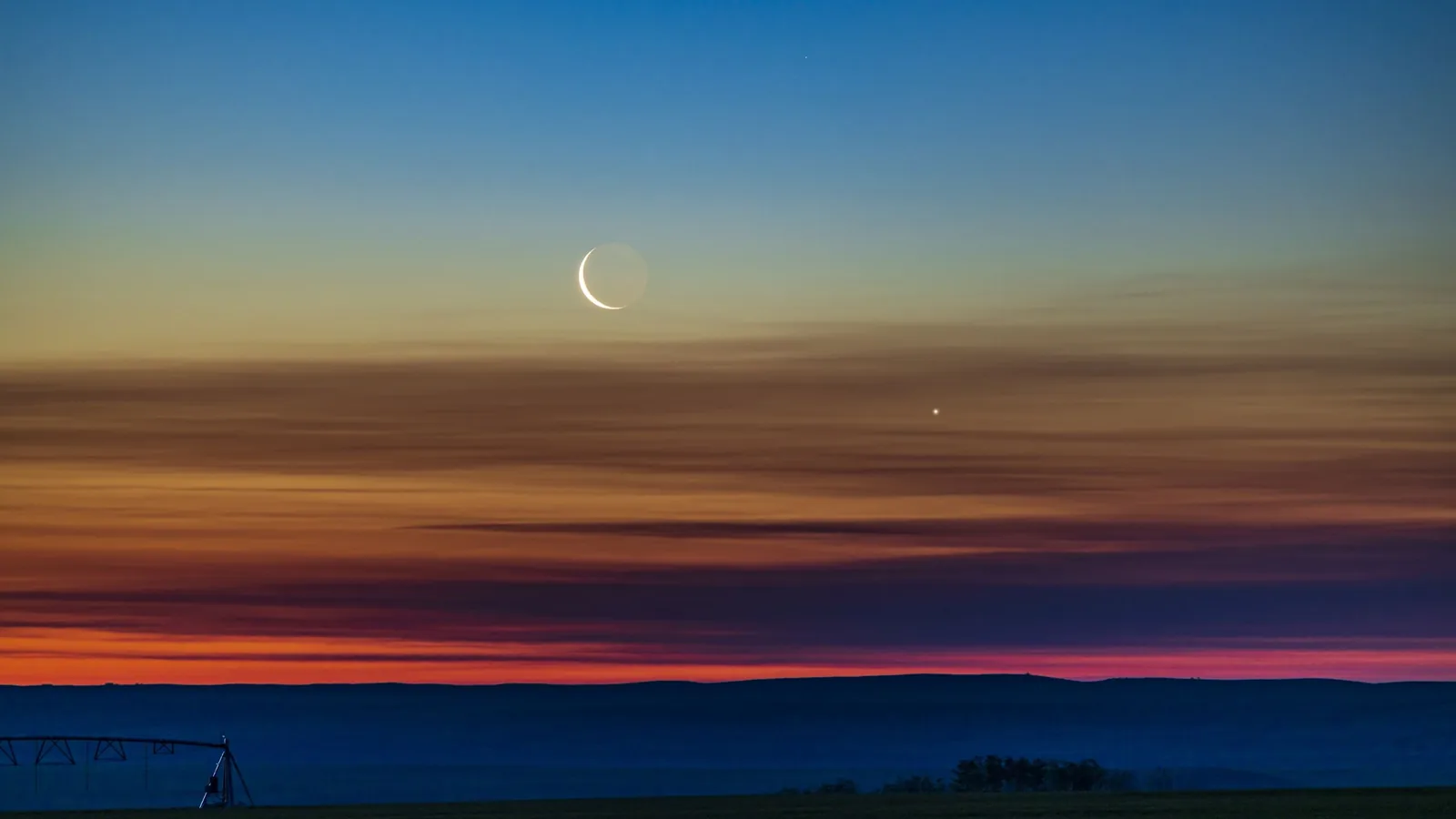
The western sky will offer a stunning celestial spectacle on the evening of May 18, 2026, as the planet Venus makes a brilliant appearance alongside a delicate, razor-thin crescent moon. This breathtaking pairing, visible shortly after sunset, is a highlight for amateur astronomers and casual observers alike. The moon, a mere 2.1 days past its new phase, will present only 7% illumination, creating a striking contrast with the radiant glow of Venus.
The apparent proximity of these two celestial bodies, while visually captivating, is an illusion of perspective. The moon resides a relatively close 224,000 miles (360,000 km) from Earth. Venus, however, is vastly more distant, situated approximately 124 million miles (200 million km) away. Despite the immense gulf between them, their alignment on this particular evening will make them appear as close neighbors in our sky, separated by about 3 degrees—roughly one-third the width of a clenched fist held at arm's length.
Understanding Apparent Brightness
While many might assume Venus is the brighter object due to its distinct point of light, the crescent moon is, in fact, significantly brighter. Venus currently shines at a magnitude of -4.0, a measure of its brightness. The thin lunar crescent, astonishingly, registers a magnitude of -7.1. This means the moon is about 17 times brighter than Venus. The reason for this seeming contradiction lies in how light is perceived. The moon's light is diffused over a larger surface area, making it appear less concentrated and thus dimmer to the casual observer, whereas Venus's brilliance is concentrated into a sharp point.
This alignment occurs as Venus's elongation from the sun increases throughout May, reaching between 24 and 32 degrees. For observers in northern temperate latitudes, Venus will be a prominent fixture in the western sky at dusk, standing about 25 degrees above the horizon. This period is also advantageous for telescopic observation of Venus. While its disk appears as a gibbous phase, approximately seven-eighths illuminated, it remains relatively small. Venus is expected to set around 10:50 p.m. local daylight time. For those wanting to catch Venus at its most visible in the evening sky during this apparition, the second week of June will offer slightly later sunsets, with the planet setting just after 11 p.m.
Such astronomical events serve as a valuable reminder of the dynamic nature of our solar system. The constant orbits of planets and moons create ever-changing celestial displays, offering opportunities for scientific observation and public engagement with space. Events like the Venus-moon pairing encourage people to look up, fostering a connection with the cosmos and highlighting the wonders that unfold nightly above us. Understanding the vast distances and relative brightness of celestial objects also provides an educational opportunity, demystifying astronomical phenomena and enhancing appreciation for the universe.