
Webb Telescope Captures Messier 77 Galaxy's Bright Core
NASA's Webb Telescope has released a stunning new image of the Messier 77 galaxy, revealing its brilliant core powered by a supermassive black hole. The galaxy is located 45 million light-years away.

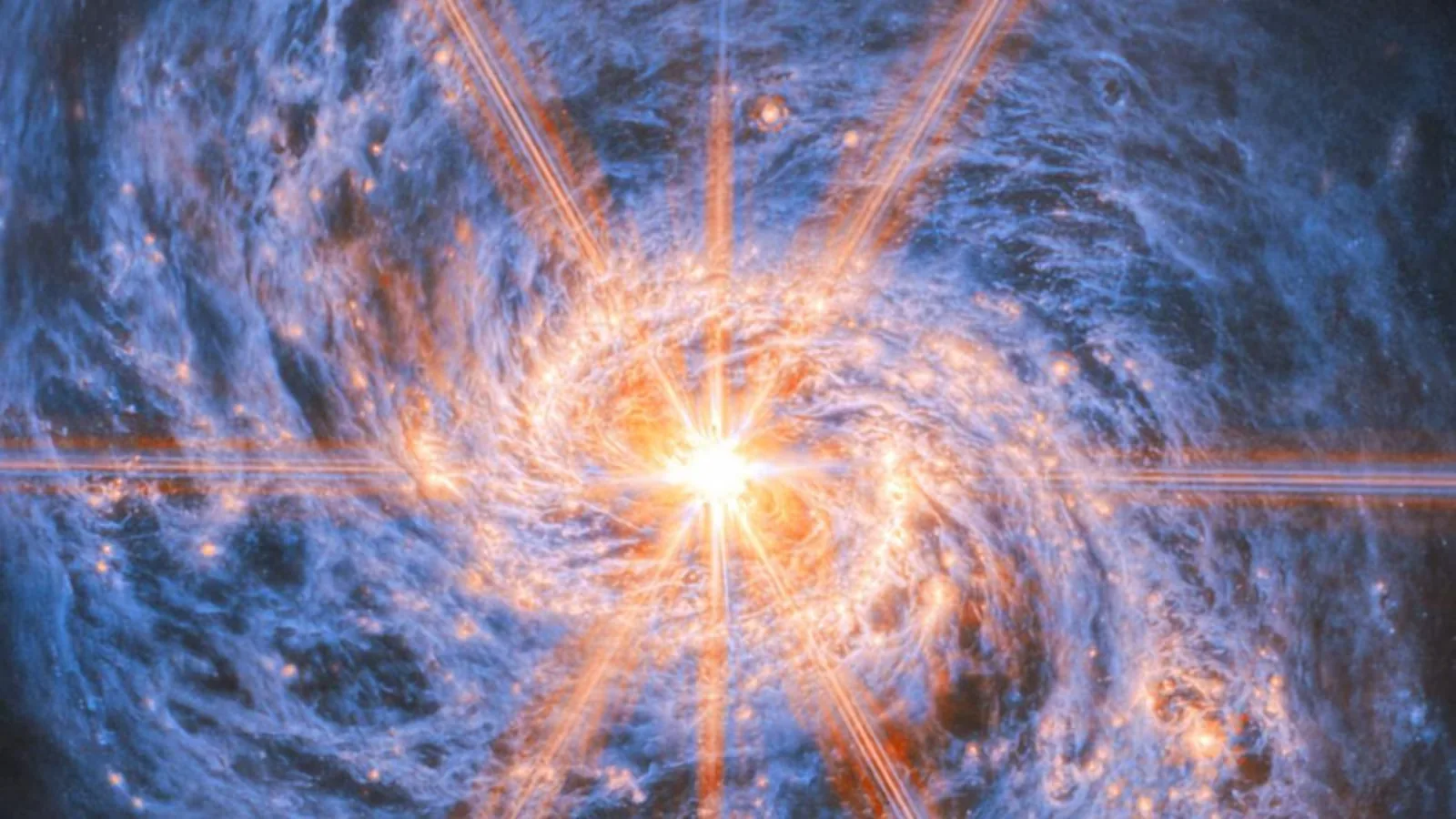
NASA's James Webb Space Telescope has unveiled a breathtaking new image showcasing the luminous heart of the spiral galaxy Messier 77. Situated approximately 45 million light-years from Earth in the Cetus constellation, the galaxy's central region is intensely bright, outshining the surrounding structures.
The extraordinary brilliance of Messier 77's core is attributed to its active galactic nucleus (AGN), which is fueled by a supermassive black hole. This black hole is estimated to be 8 million times the mass of our sun. As gas and dust are drawn into a rapid orbit around this colossal object, they become superheated, emitting intense radiation that Webb's instruments are designed to detect.
The image was captured using Webb's Mid-Infrared Instrument (MIRI), which allows astronomers to peer through the cosmic dust that often obscures the central regions of galaxies. This capability is crucial for understanding the processes occurring around supermassive black holes, including star formation and the feeding behavior of these powerful cosmic entities.
Unveiling the Hidden Nucleus
Messier 77 has long been a subject of astronomical study, but the Webb telescope's advanced capabilities provide an unprecedented view. Previous observations, including those from the Hubble Space Telescope, offered valuable insights, but MIRI's sensitivity in the mid-infrared spectrum enables Webb to penetrate deeper into the galaxy's dusty shroud. This allows scientists to study the intricate structure of the accretion disk surrounding the black hole and map the distribution of gas and dust with remarkable detail. The data gathered will contribute to a better understanding of how AGNs impact their host galaxies and the wider intergalactic medium.
The release of this image marks another significant milestone for the Webb Space Telescope, which began its scientific operations in 2021. Since then, it has consistently delivered spectacular images and groundbreaking data, revolutionizing fields from exoplanet atmospheres to the earliest galaxies in the universe. Its sophisticated instruments are pushing the boundaries of astronomical observation, offering new perspectives on cosmic phenomena that were previously inaccessible.
Studying galaxies like Messier 77 is vital for comprehending the evolution of the universe. Supermassive black holes play a critical role in galaxy formation and evolution, influencing everything from the rate of star birth to the distribution of matter. By observing the energetic processes within AGNs, astronomers can piece together the complex history of cosmic structures and the forces that have shaped them over billions of years. This latest image from Webb promises to fuel further research and discovery in the field of extragalactic astronomy.
The galaxy Messier 77, also known as NGC 1068, is located in the constellation Cetus. The details revealed by the NASA telescope highlight the ongoing work of scientists to unravel the mysteries of the cosmos. The insights gained from such observations contribute not only to our fundamental understanding of astrophysics but also inspire public interest in space exploration and scientific endeavors.