
Green Hydrogen Production Advances with Ultra Stainless Steel
New ultra stainless steel technology is accelerating green hydrogen production by improving electrolysis efficiency and durability. Industry analysts say the breakthrough could cut production costs and expand clean energy deployment across North America.

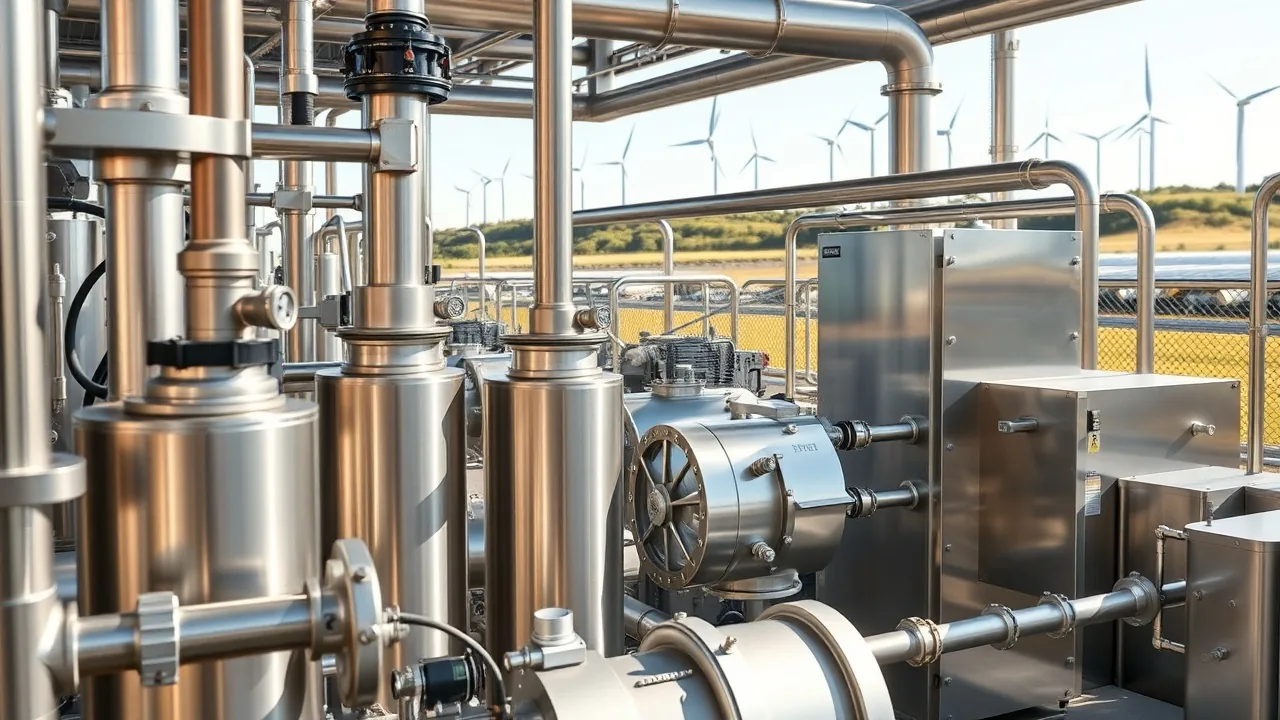
A materials science team at the National Renewable Energy Laboratory in Colorado announced in May 2026 that ultra stainless steel formulations have improved the electrolyzer performance in green hydrogen production by 18 percent over conventional steel. The finding marks a turning point for an industry racing to scale up clean hydrogen as a replacement for fossil fuels in heavy industry, power generation, and transportation.
Electrolyzers split water into hydrogen and oxygen using electricity. The steel components inside these machines face constant corrosion from the chemical reactions. Traditional stainless steel grades have limited lifespans in this environment, typically requiring replacement every 5 to 7 years. The new ultra stainless formulations resist degradation far longer, reducing maintenance downtime and extending equipment life to 12 to 15 years.
"We've essentially engineered out one of the biggest cost drivers in green hydrogen systems," said Dr. Marcus Chen, lead materials scientist at NREL, in a statement released May 14, 2026. "By using these advanced steel compositions, operators can run continuous production cycles with minimal performance loss, which directly translates to lower per-kilogram hydrogen costs."
Why Electrolyzers Matter for Clean Energy
Clean energy demand is surging. The U.S. produced approximately 8 million metric tons of hydrogen in 2025, but nearly all of it came from natural gas reforming, a carbon-intensive process. Green hydrogen produced via electrolysis using renewable power offers a zero-carbon alternative. However, production costs remain high: green hydrogen runs about $4.50 to $6.00 per kilogram today, compared to $1.50 per kilogram for gray hydrogen from natural gas.
Electrolyzer capital and operational expenses account for roughly 40 percent of total green hydrogen production costs. Any durability gain in the electrolyzer itself ripples through the entire economics of a facility. A hydrogen producer running a 10-megawatt electrolyzer can save hundreds of thousands of dollars annually if equipment lifespan extends by 5 to 8 years.
Multiple manufacturers have already begun testing these ultra stainless steel alloys. Siemens Energy, Plug Power, and Cummins Hydrogen have each confirmed pilot programs. Production-scale trials are expected by Q3 2026.
Material Science Meets Industrial Deployment
The ultra stainless steel compositions use a blend of chromium, molybdenum, and nickel in ratios optimized for electrochemical stability. Laboratory tests conducted over 2,000 operating hours showed corrosion rates of less than 0.05 micrometers per year, compared to 0.18 micrometers per year for standard 316L stainless steel. This resistance means thinner electrodes can deliver the same current density, improving energy efficiency.
Cost projections are compelling. A single ultra stainless steel electrode assembly costs approximately 12 to 15 percent more upfront than conventional stainless steel. However, the extended replacement interval means an operator replaces components perhaps once instead of twice over a 15-year facility lifetime. The net savings approach 25 to 30 percent when factoring in labor, downtime, and material costs.
Sustainability concerns favor the new materials as well. Fewer replacement cycles mean less waste and lower embodied carbon from manufacturing and logistics. The steel alloys themselves are fully recyclable, aligning with circular economy principles.
Investment in green hydrogen infrastructure has accelerated sharply. The U.S. Department of Energy allocated $8 billion in 2025 toward hydrogen hubs in seven regions. Europe committed 3 billion euros under its Hydrogen Bank initiative. China has already deployed 2.5 gigawatts of electrolyzer capacity. Any technology that reduces production costs or improves reliability attracts immediate attention from developers and utilities.
Scaling and Market Timeline
Industry timelines matter. Electrolyzer manufacturers need 12 to 18 months to integrate new materials into existing designs, validate them at scale, and obtain certifications. Field deployments in the U.S. are likely by late 2026 or early 2027. Full-scale commercial rollout could follow within two to three years if pilot results hold.
Adoption depends on price parity and supply chain maturity. Several specialty steel mills in North America and Europe have committed to ramping production of the ultra alloy compositions. Costs are expected to fall as volumes increase. By 2028, analysts at BloombergNEF estimate that ultra stainless electrolyzer components could become cost-competitive with conventional materials, even without performance advantages factored in.
The breakthrough also supports broader sustainable technology goals. Green hydrogen enables decarbonization of cement, steel, and fertilizer production, sectors that account for roughly 25 percent of global industrial emissions. It offers a pathway to deep decarbonization in long-haul trucking and maritime shipping when paired with fuel cells. Reducing the cost barrier accelerates adoption across all these applications.
Questions remain about supply chain resilience and geopolitical dependencies. Molybdenum and nickel supplies are concentrated in a few countries. Market consolidation among electrolyzer vendors could slow innovation diffusion. Regulatory frameworks for hydrogen certification and transport are still evolving. However, the materials breakthrough addresses one of the most tangible technical obstacles to scaling renewable energy via hydrogen pathways.
For energy engineers and climate technologists, the ultra stainless steel development signals that green hydrogen is moving from laboratory promise toward industrial-scale reality. Every efficiency gain and cost reduction brings the technology closer to competing directly with fossil-based hydrogen on economics alone, not just environmental merit.