
Extinct Ice Age Toad Species Unearthed at La Brea Tar Pits
Paleontologists have identified a new extinct species of spadefoot toad, *Spea labreae*, from fossils discovered at the La Brea Tar Pits in Los Angeles. This marks the first extinct ice age amphibian found at the site.

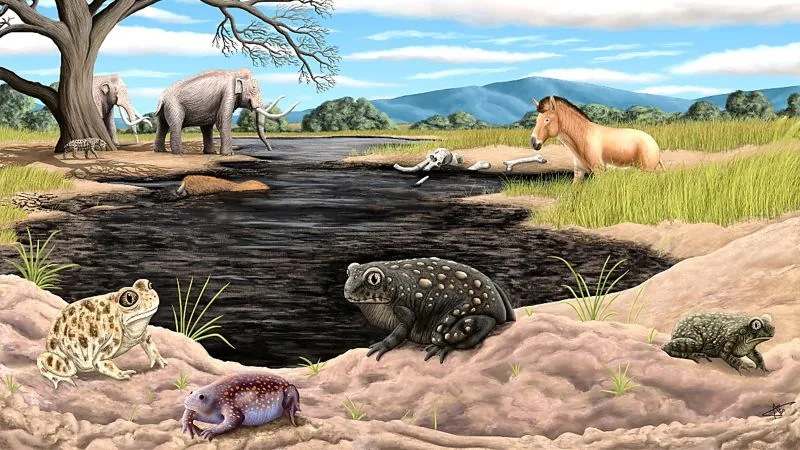
Paleontologists have identified a new species of extinct ice age toad, dubbed *Spea labreae*, from fossil fragments unearthed at the famed La Brea Tar Pits in Los Angeles. This discovery, published Wednesday in the Journal of Vertebrate Paleontology, represents the first extinct amphibian from the Pleistocene epoch found at the tar pits and only the second such fossil ever recovered in North America. The groundbreaking find offers new insights into the prehistoric climate and ecosystems of ancient Los Angeles.
The two distinct fossils, both fragments of the sacro-urostyle—a bone connecting the lower spine to the hips in amphibians—were originally excavated in 1929 but remained unstudied until 2023. Researchers, including lead author Dr. J. Alberto Cruz, a research associate at La Brea Tar Pits and researcher for Mexico’s Quinametzin Paleontological Research Center, were sifting through overlooked collections when the tiny fragments, each about 1 centimeter (0.4 inch) long, caught their attention. Cruz, whose expertise lies more in paleoecology and paleogeography than taxonomy, expressed excitement over identifying his first new species.
"I’m more like a paleoecologist and paleogeographer, not a taxonomist. So, it is my first new species. For me, it’s very exciting," Dr. Cruz stated. Amphibian bones are notoriously small and fragile, making them rare discoveries. The La Brea Tar Pits, however, provide an exceptional environment for preserving such delicate fossils, shielding them from weathering, decay, and scavengers, and preventing degradation from water, oxygen, and microbial activity.
A Glimpse into a Prehistoric Los Angeles
The preservation qualities of the asphalt have long made the La Brea Tar Pits a treasure trove of ice age megafauna, yielding remains of mammoths, saber-toothed tigers, and dire wolves. However, the discovery of *Spea labreae* underscores the tar pits' potential for revealing smaller, often overlooked prehistoric life. Dr. Emily Lindsey, curator and excavation site director at the Samuel Oschin Center for Global Ice Age Research at La Brea Tar Pits and a co-author of the study, noted that smaller fossils often receive less attention than those from larger animals, leading to their neglect in early excavations worldwide.
Comparing the new fragments to other amphibian bones in the La Brea collection and specimens from the Natural History Museum of Los Angeles County and the University of California, Berkeley, Cruz identified key distinctions. The axe-shaped sacro-urostyle of the newly discovered toad was notably smaller than that of known species, confirming it as a previously unknown extinct amphibian. While precise dating is challenging without damaging the specimens, researchers estimate the toad existed within the last 60,000 years, coinciding with the tar pits' active period.
"We’ve now doubled the number of known extinct ice age amphibians from North America, and so that’s a pretty big finding," Dr. Lindsey commented. "People didn’t even bother really collecting small fossils until maybe the latter part of the 20th century. So, they were ignored largely in early excavations around the world."
The research also led to the identification of another unusual amphibian fossil within the same collection: the Mexican burrowing toad (*Rhinophrynus dorsalis*). This species, the only living member of the family Rhinophrynidae, is typically found in the lowlands of Central America, Mexico, and southern Texas—thousands of miles from Los Angeles. Its presence in the tar pits suggests that prehistoric Los Angeles may have possessed a climate more akin to the humid, tree-rich environments preferred by this species today. This finding adds another layer to our understanding of ancient Los Angeles and its paleoclimate.
Amphibians, due to their dependence on specific water and temperature conditions, are highly sensitive to environmental changes. Their fossils are therefore invaluable for studying past climates and informing conservation efforts through paleobiology. "It’s kind of like a time machine," Dr. Lindsey explained. "We can go and actually kind of rewind the clock and see what happened, and then kind of use that to make predictions about how things are going to continue changing." Researchers hope future studies will elucidate the specific habitat dependencies of these ancient toads.
David Blackburn, associate director of research and collections at the Florida Museum of Natural History, who was not involved in the study, highlighted the significance of the find. He noted that while frog fossils are rare, they are likely more common than previously thought and often overlooked due to paleontologists' general unfamiliarity with amphibian bone variation. "It is surprising that relatively few frog fossils have been previously recovered from La Brea, and I’m confident more will turn up," Blackburn stated.
Susan Evans, a professor at University College London, echoed the sentiment, emphasizing that amphibians serve as crucial indicators of local environmental conditions. "Many larger animals eat frogs (and other small animals) and may carry them far away from their normal habitat before dumping the bones," Evans cautioned, explaining potential anomalies in fossil distribution. "That can leave small animal remains in places you wouldn’t expect." Nonetheless, the study of these small creatures is increasingly recognized for its vital contribution to understanding past ecosystems and predicting future environmental trends.