
Katalyst Pursues NASA's Swift Satellite in Historic Rescue Mission
Katalyst's Link satellite has successfully launched and is now attempting to rendezvous with and boost NASA's aging Swift observatory, marking a pioneering effort in robotic satellite servicing.

High above the Pacific Ocean, Katalyst Space Technologies successfully launched its Link satellite on Independence Day weekend to begin a critical, weeks-long pursuit of NASA’s Swift astronomy observatory, which is perilously close to falling out of orbit. This groundbreaking endeavor represents the first mission of its kind, aimed at rescuing a satellite through commercial robotic intervention. NASA had solicited proposals less than a year ago from companies capable of rapidly developing and deploying a small satellite to attach to Swift and elevate its orbit, preventing its premature demise.
Katalyst Space Technologies answered this call with a compelling proposal and was awarded a contract last September. Just over nine months later, Katalyst’s nearly half-ton Link satellite is operational in orbit. For the space industry, building, testing, and launching a first-of-its-kind satellite of this magnitude in under a year is an extraordinary feat, as such development typically takes several years.
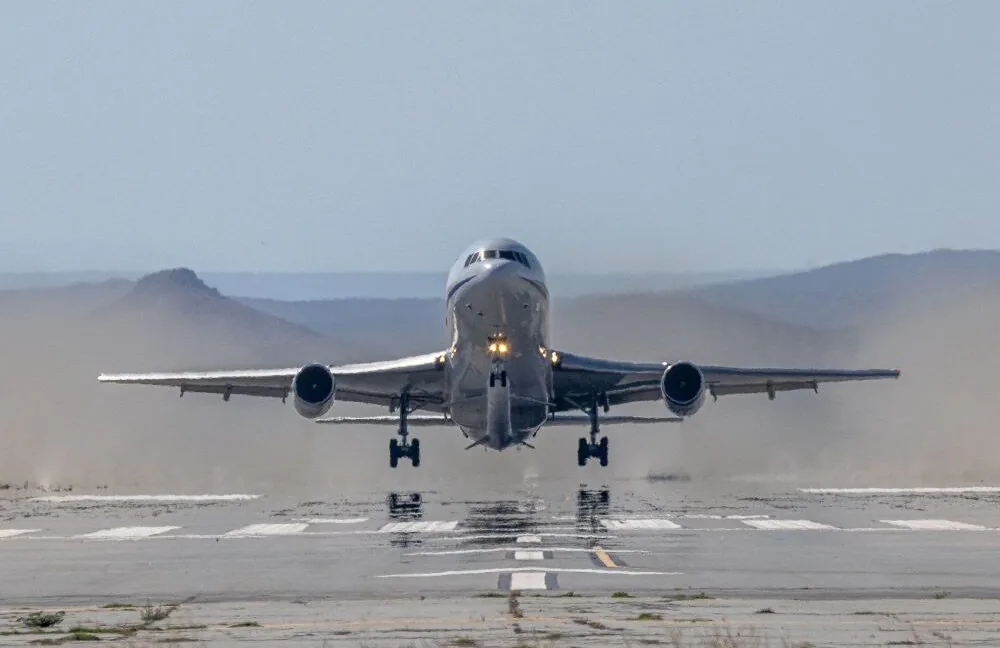
Technicians secured the Link satellite within the nose cone of a Northrop Grumman Pegasus XL rocket last month at NASA’s Wallops Flight Facility in Virginia. An aircrew then transported the rocket and its L-1011 carrier aircraft from Virginia to the U.S. Army’s Ronald Reagan Space and Missile Test Range on Kwajalein Atoll, a facility leased from the Marshall Islands situated over 2,000 miles southwest of Honolulu. After a period of waiting for favorable weather conditions, the rocket and L-1011 took off from the atoll.
The Pegasus XL rocket was released at 4:36 am EDT (08:36 UTC) on Friday from a cruising altitude of 41,000 feet. Five seconds later, the rocket's first stage ignited, commencing its journey to orbit. The Pegasus XL's three solid-fueled motors accelerated the payload to orbital velocity in just under eight minutes. The rocket's upper stage then executed a preprogrammed sequence, deploying the Link satellite approximately 13 minutes after launch. Katalyst confirmed communication with the Link satellite shortly after deployment, verifying its survival through the launch phase.
Katalyst opted for the Pegasus rocket, which has seen limited use with only one flight in the past seven years, because the Swift rescue mission required insertion into an unusually low-inclination orbit to intercept its target. Swift's orbit is inclined at 20.6 degrees to the equator. Launching from the equatorial Pacific resolved the challenge of reaching this specific orbit, which would have necessitated a larger, more expensive rocket from a spaceport like Cape Canaveral, Florida.
The Complex Task Ahead for Link
While the launch itself was a success, significant challenges remain for Katalyst. The Swift rescue mission marks the debut flight for this particular version of the Link satellite. Beyond standard systems for power, attitude control, and communication, the Link spacecraft is equipped with cameras and sensors for autonomous navigation towards Swift, along with three robotic arms designed for grappling. Once a secure connection is established, three plasma thrusters will propel both Link and Swift to a higher orbit.
“Over the next several weeks, Katalyst will perform checkout procedures for Link, including assessments of its propulsion, sensor, and navigation systems,” NASA stated. “Link will then approach Swift and complete a survey of the 21-year-old observatory, before capturing and lifting it over the course of several months.”
However, Swift was not originally designed for orbital rendezvous. Engineers are uncertain about the condition of Swift’s thermal insulation, necessitating a cautious approach by ground controllers to determine optimal capture points for Link’s robotic arms. Officials from NASA and Katalyst acknowledge the inherent risks. “All this is challenging and risky,” said Kieran Wilson, principal investigator for the Link satellite at Katalyst. “There’s a lot of spacecraft that have had far longer development cycles with far more funding behind them that have failed for mundane reasons.”
The successful launch of Link is a considerable accomplishment given the tight timeline. Swift is projected to fall below an altitude of 300 kilometers (186 miles) by October, at which point increasing atmospheric drag would make a rendezvous attempt by Link extremely difficult. “One thing that we’re relying on for Swift is its ability to maintain its own pointing control,” Wilson added. “There are no features on Swift that are designed to capture. There’s a lack of documentation to even help us figure out where those features would be if they existed, but we are confident that Swift can point well.”
The NASA Swift observatory, a $500 million asset, is crucial for detecting gamma-ray bursts, the most energetic explosions in the universe. Despite its age, astrophysicists continue to rely on its multi-wavelength instruments for follow-up observations by other observatories. Beyond saving Swift, this mission serves as a critical test for a new era of robotic satellite servicing. While NASA previously serviced the Hubble Space Telescope with human astronauts, a robotic platform offers a safer and potentially more cost-effective solution for a wider range of applications. “This is a historic mission,” stated Robert Lamontagne, vice president of strategic partnerships at Katalyst. “Some would call it the first of its kind, a robotic spacecraft that can go and capture an unprepared satellite. It’s a commercial mission, first and foremost. It’s doing an operational, real-world objective. It’s not just a demonstration. We’re doing this as a service.”
Lamontagne elaborated on Katalyst's vision: “What I mean by that is, for years and years, folks have thought about space as something where you build a satellite, you launch a satellite, it does its mission, and at the end of the mission, it gets disposed of, either it re-enters, or it goes to a graveyard orbit. That’s a throwaway type of model. We think the spacecraft operator should no longer be constrained by the silly decisions that we made before launch. You should be able to refuel, reposition, repurpose, repair, and even upgrade satellites, even if they were never prepared for it, and that’s where Katalyst is trying to change everyone’s mindset.”