
Massive Star Supernova Observed by Global Telescope Network
A rare supernova, originating from a star 20 times the sun's mass, has been meticulously observed by a coordinated network of international telescopes. Scientists captured detailed data on the star's death, revealing surprising aspects of the explosion.

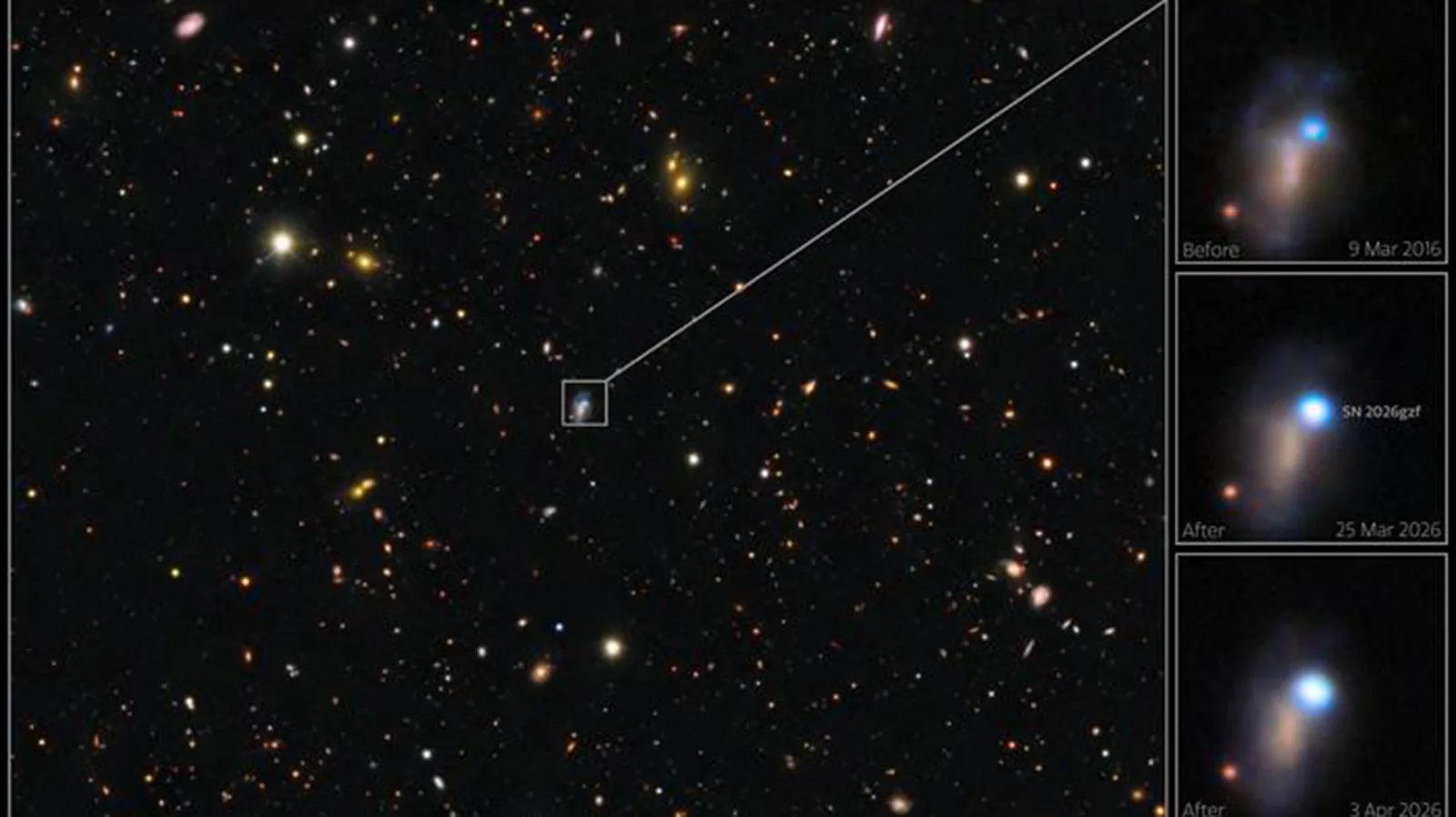
An international collaboration of telescopes has captured the most detailed observations to date of a massive star's death in a spectacular supernova explosion. The event, first detected as an X-ray flash by China's Einstein Probe space telescope in March 2026, was quickly identified by ground-based observatories as a supernova. A global network of instruments, including the Vera C. Rubin Observatory and the Dark Energy Spectroscopic Instrument, then tracked the cosmic event, located 500 million light-years away. The findings were published on July 14, 2026, in The Astrophysical Journal Letters.
Astronomers successfully observed the crucial 'shock breakout' – the initial emission of light from the explosion as a powerful shock wave erupted. This particular supernova was classified as a Type Ic broad-lined (Ic-BL) supernova, a type often associated with powerful gamma-ray bursts due to near-light-speed jets. However, this event presented anomalies: its shock breakout was unusually faint, and no gamma-ray bursts were detected.
Surprising Observations and Explanations
Brendan O'Connor, an astrophysicist at Carnegie Mellon University and co-author of one of the studies, stated, "Follow-up observations using the most sensitive facilities found no evidence" of the expected gamma-ray bursts. Researchers are exploring theories such as the jet being "choked" by the star's surface or surrounding material. The star itself was approximately 20 times the mass of the sun, identified as a Wolf-Rayet star that had depleted its hydrogen fuel early in its life. Before its collapse, it periodically expelled shells of hydrogen and helium, leaving behind carbon and oxygen, which created visible structures observed as distinct events.
The Vera C. Rubin Observatory in Chile played a key role, serendipitously observing the supernova's location as part of its ambitious 10-year sky survey, which commenced in late June 2026. "Thanks to Rubin's rapid cadence and unprecedented sensitivity, continued observations are expected to provide detailed, long-term records of the supernova as it evolves for years to come," the science teams reported. The Rubin Observatory's mission is to map the entire southern sky repeatedly, creating a dynamic record of cosmic phenomena including millions of supernovas, asteroids, and comets.
Complementing Rubin's observations, the Dark Energy Spectroscopic Instrument (DESI), located on the National Science Foundation's Nicholas U. Mayall Telescope at Kitt Peak National Observatory in Arizona, was activated for follow-up analysis. DESI confirmed the explosion as an Ic-BL supernova. Furthermore, scientists analyzed a decade of data from the Dark Energy Camera on the Víctor M. Blanco Telescope in Chile. They identified a 'blue source' at the supernova's future location, offering insights into the star system's prior state and environment.
A research team led by Jillian Rastinejad, an astronomer at the University of Maryland, College Park, and co-author of the second study, utilized the Gemini Multi-Object Spectrographs on the Gemini North telescope in Hawaii and Gemini South in Chile. These observations also confirmed the Ic-BL classification without detected jets, and provided archival data on the star's pre-explosion structure and surroundings. "Our observations allowed us to study the physics of three pieces of this explosion: the X-ray shock breakout, the accompanying supernova, and the interaction of the supernova with material previously cast out by the dying star," Rastinejad explained. "With this information we were able to map out the structure of the material surrounding the star and understand the star's violent lifestyle before it collapsed.". This coordinated observation effort provides an unprecedented look into the final moments of massive stars and the complex physics governing stellar death.