
Sun May Have Swallowed Super-Earth, Hiding Chemical Clues
New research suggests our sun may have consumed a super-Earth planet billions of years ago, leaving chemical fingerprints deep within its core. This could explain longstanding mysteries about the sun's structure and composition.

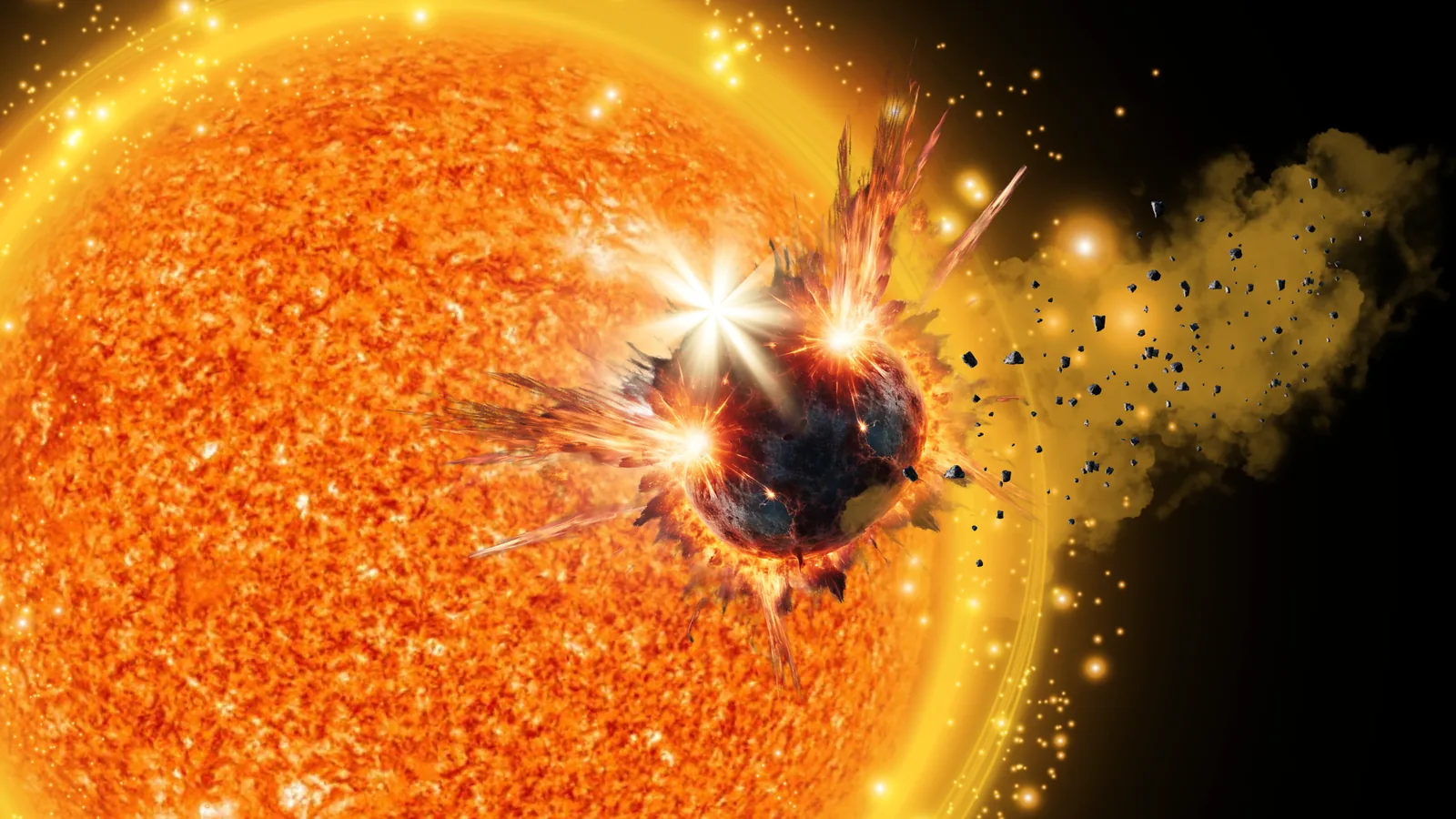
Our sun may have consumed a super-Earth planet in its early history, with evidence potentially still hidden deep within the star's interior, according to new research. Scientists propose that the fingerprints of this ancient planetary engulfment could explain several unexplained characteristics of our star, including its internal structure and a depletion of lithium.
The study, led by Mutlu Yildiz of Ege University in Turkey, suggests that a planet several times more massive than Earth may have fallen into the young sun. "Our new study suggests that a planet several times more massive than Earth may have fallen into the young sun and left a lasting chemical imprint deep inside it," Yildiz stated. This theory could resolve discrepancies between current observations of the sun and predictions from standard models of stellar evolution.
Specifically, the research points to differences in the sun's convection zone depth and its internal sound-speed structure. It may also account for why the sun's surface shows a lower-than-expected abundance of lithium. "By modelling the sun's evolution and comparing the results with precise observations of its interior, we find that the ingestion of a super-Earth could help explain long-standing differences between standard solar models and observations, including subtle changes in the sun's internal structure and its depleted lithium abundance," Yildiz explained.
Unexplained Solar Anomalies
Researchers were motivated to investigate this possibility by a desire to understand if these solar anomalies could stem from a common origin in the sun's early chemical history. During its infancy, stars like our sun are typically surrounded by vast, flattened disks of gas and dust known as protoplanetary discs. Material can readily move between these discs and the central star. "Since planets are made of material that is chemically different from the gas in the disc, we wondered whether the early engulfment of a planet could have left a chemical signature inside the young sun," Yildiz noted.
To test this hypothesis, Yildiz and his colleagues utilized advanced stellar evolution software. They simulated various scenarios of planetary ingestion by the sun. Their findings indicated that the most plausible explanation for the sun's current characteristics involved the consumption of a planet between five and ten times the mass of Earth – a category known as a super-Earth. "We thought planetary engulfment might affect the solar structure but did not expect the calculations to converge on such a specific super-Earth mass range," said Professor Yildiz. "That was one of the most interesting outcomes of the study.".
This new theory builds upon previous work suggesting that one or more super-Earths might have formed in the orbital vicinity of Mercury, the innermost planet. These celestial bodies could have subsequently migrated through the protoplanetary disc surrounding the infant sun before colliding with it. However, the current study offers a potential mechanism for how these collisions might have occurred and left a lasting impact.
The team's model does not require that the planet was entirely consumed. The research is currently based on computer simulations and the analysis of unexplained solar features. Nonetheless, the scientists are optimistic that the predicted structural and chemical signatures of such a planetary engulfment could still be detectable within our sun. "The earlier work proposed that a super-Earth could have formed and migrated into the young sun. Our paper asks whether the sun itself could still carry observable evidence that such an engulfment actually happened, and we believe it could," Yildiz concluded. "The next step is to see if these fingerprints can be independently detected." The implications extend beyond just understanding our own sun, potentially offering insights into the evolution of other stars and planetary systems.