
Webb Telescope Detects Methane on Interstellar Comet 3I/ATLAS
The James Webb Space Telescope has identified methane gas on interstellar Comet 3I/ATLAS, a finding that suggests a unique formation environment. The detection marks a first for an object from beyond our solar system.

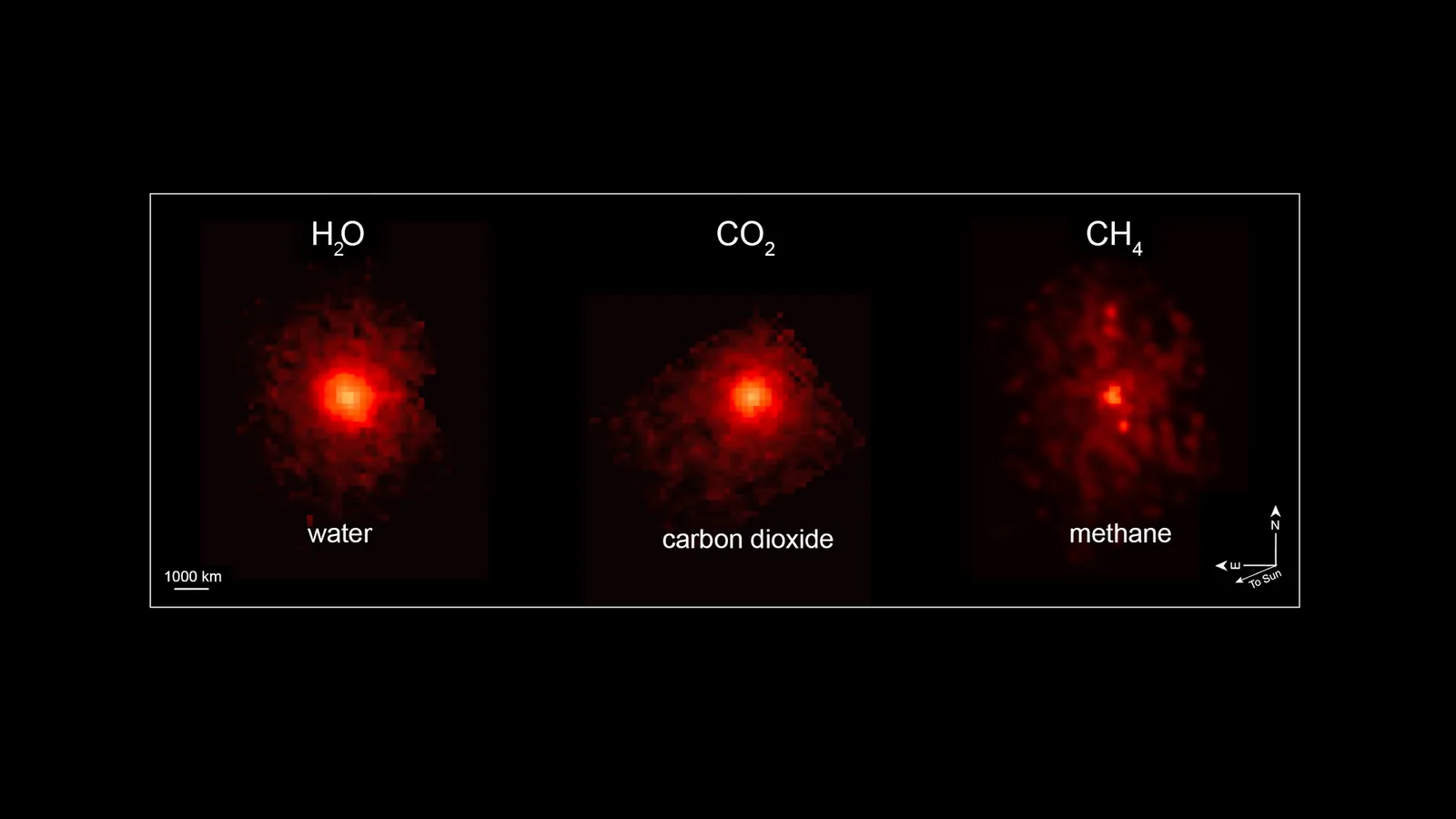
The James Webb Space Telescope (JWST) has detected methane gas emanating from Comet 3I/ATLAS, an interstellar object that recently passed through our solar system. This marks the first direct chemical fingerprint of methane from an object originating outside our solar system. The observations, made in December 2025, provide crucial insights into the comet's composition and the conditions under which it formed billions of years ago.
JWST's Mid-Infrared Instrument (MIRI) captured detailed data as Comet 3I/ATLAS traversed the solar system. The telescope observed the comet on two occasions: between December 15-16, when it was approximately 330 million km from the Sun, and again on December 27, when it had moved to about 380 million km from the Sun. This dual observation allowed scientists to analyze the distribution of various gases, including water vapor, carbon dioxide, and methane, around the comet's nucleus.
Researchers were particularly intrigued by the high concentration of methane, which appeared to be released from beneath the comet's surface. This suggests that the methane was protected from evaporation until the Sun's heat penetrated deeper into the comet's icy structure during its close approach. The ratio of methane to water vapor detected is notably higher than typically observed in comets formed within our own solar system.
A Unique Chemical Signature
In addition to methane, JWST's observations confirmed that Comet 3I/ATLAS is unusually rich in carbon dioxide. The release rate of carbon dioxide relative to water is significantly higher compared to comets native to our solar system. These chemical disparities strongly indicate that Comet 3I/ATLAS originated in a vastly different environment with distinct chemical processes at play compared to the solar system's cometary bodies.
"These findings point to a very different formation environment and chemistry than the vast majority of comets that formed within our Solar System," according to a statement from the European Space Agency. The unprecedented detail captured by JWST is attributed to its Medium Resolution Spectrometer, an instrument capable of breaking infrared light into its constituent wavelengths. This allows for precise identification and mapping of gases throughout the comet's coma.
The scientific community is eager to leverage this data to refine models of planetary formation and the distribution of organic molecules throughout the galaxy. Understanding the origins of interstellar objects like Comet 3I/ATLAS offers a unique window into the chemistry of planetary systems beyond our own. The results of these observations were recently published in The Astrophysical Journal Letters, detailing the methods and significance of this groundbreaking discovery.